
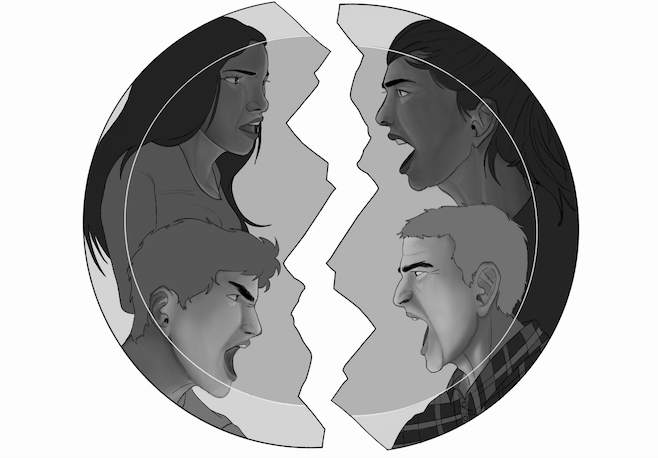
“Friendsgiving” is a relatively young invention, but it’s already become a cultural escape hatch. Instead of squeezing around a table with relatives you see twice a year and argue with three times as often, you gather with friends who usually think like you, talk like you and and share the same outrage over politics.
No vaguely racist cousins. No mildly creepy uncles. Just the people you actually choose. For many, that comfort becomes addictive. Friendsgiving slowly shifts from a lighthearted extra celebration to the preferred one — a holiday without friction, without lectures, without that one relative who starts every sentence with “back in my day.”
Except the racist cousins are doing the same thing. They, too, are peeling off to celebrate with like-minded friends, carving up their turkey in ideological harmony. And suddenly, everyone is trapped in the same pattern: sticking with what’s easy, and letting the harder relationships fall apart.
Personally, my extended family has extremely different political views than my own, but I still respect them as people. I still share the same Christmas ham with them every year and enjoy my time with them, but this isn’t the case for everyone.
Kamley Branch (’26) expands on this idea. “My extended family has avoided traveling during the holidays because of political differences, and honestly I don’t blame them, some of the things they say are a lot to take in.”
The question of whether you can remain close to people whose political beliefs clash with yours dominated the last election cycle. As friends posted content favoring one candidate, people felt blindsided. How had you spent years laughing with someone who believed in that?
With friends, the answer feels simpler. Don’t like their worldview? Stop hanging out. Block them. Make new friends. But family is stickier. You can’t just “un-add” an aunt.
“It’s difficult because obviously you love these people, but when some of their beliefs oppose your own on a fundamental level, it’s hard to be around a person like that.” Ann Claire Krauza (’28) said “For example, debating tax brackets is one thing, but arguing over whether gay marriage should be legal or not is a completely different conversation.”
And that’s the core of it. When disagreements are about human rights, not tax brackets, people retreat to friends because it’s safer. With friends, you can talk freely without bracing for a sudden argument about the president’s policies. Not everything you say is political, but if you’re even mildly thoughtful, a lot of your beliefs tie back to values that build poltitical views.
So if you’re one of the people constantly asking, “Why is everything political these days?” — that’s your answer. It always has been.
These divides are understandable. No one grows up in the same environment or under the same pressures. But the result is that families splinter into tribes.
“My parents are immigrants from Cuba who hold incredibly conservative beliefs, with most of it originating from their fear of communism,” Bryan Velazquez (’26) said. “My brother’s side on the other hand, introduced a lot of liberal views. Something as simple as the price of gas gets turned into a whole debate on the presidency over dinner.”
The Springtide Research Institute tried to measure this tension in its 2024 article,“The Majority of Young People Won’t End a Friendship over Politics.” Its survey of 6,669 people ages 13–25 found that “just 12% said they would stop speaking to someone they strongly disagree with politically, and only 5% strongly agreed with that statement.”
But in real life? It’s a different story. Friendsgiving exists because many people are quietly choosing emotional safety over family obligation. One skipped Thanksgiving becomes two skipped Christmases, and suddenly you’re a guest in the family you grew up in.
The article continues, “Meanwhile, 58% said it is possible to have a close relationship with someone who doesn’t share their political views.” Sure — but that still leaves 42% who aren’t so sure. And even within the 58%, that’s about possibility, not preference.
And much of this political divide goes hand in hand with the generational gap. Older relatives tend to hold onto long-running beliefs, sometimes untouched by new information.
“For me , the most annoying part is dealing with family members who are uninformed about politics. They’re arguing off of the same beliefs they’ve had for decades, not taking into account anything that’s happened recently,” Krauza said.
Young people, meanwhile, are hyper-aware that their future is the one on the line. As John F. Kennedy once said, “The future promise of any nation can be directly measured by the present prospects of its youth.” So trying to unpack complex current issues with someone quadruple your age can feel pointless.
But here’s the uncomfortable truth: your relatives aren’t disposable. These are the people who watched you grow up, who baby-sat you, who know old stories about you that your friends don’t. Friends are easy to swap out. Family isn’t — and maybe shouldn’t be.
“I don’t care if someone disagrees with me politically, even if it is a huge disparity. I believe in the importance of loving the people around you, and there’s no reason for politics to get in between that,” Velazquez said.
Maybe the solution isn’t choosing between friends and family, but learning to sit at the table with both — even if an uncle can’t stop saying “back in my day.” Learning to respectfully disagree has been drilled into us since preschool for a reason. Disagreement sparks change, whether it’s with your mom, your teacher or your future employer.
And honestly, navigating political tension with the people who raised you is training for the rest of your life. If you can learn to coexist, communicate and still care for people who see the world differently under your own roof, you’ll be better equipped to handle the unpredictable disagreements waiting for you everywhere else.