
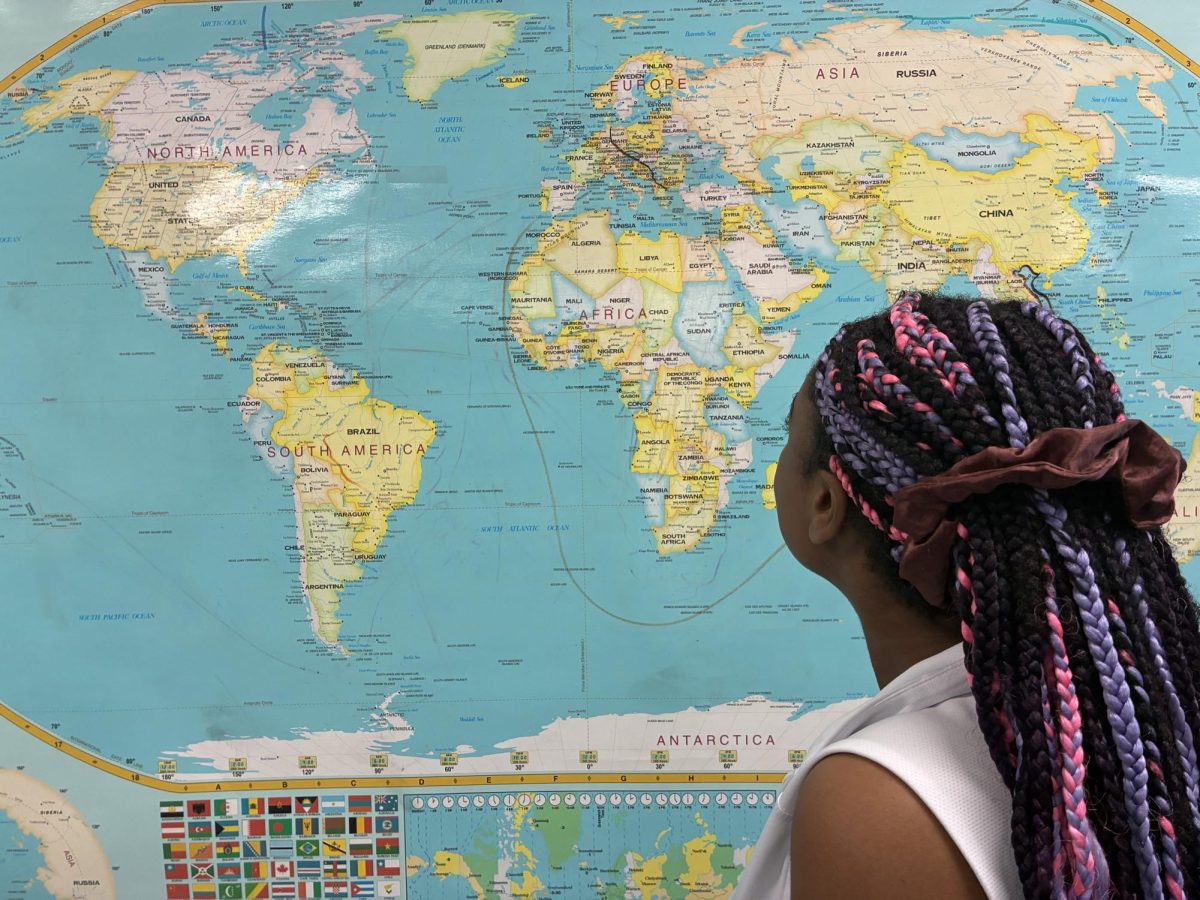
There is an old, popular Jimmy Kimmel street interview where people are asked to name a country. Obviously, because it was aired, almost nobody could. You can hear the audience’s laughing reactions at the ignorant answers and yet, if the video serves as any model for the entire population, many of them shouldn’t be able to answer that question themselves. Outside of the United States, there is a stereotype that contends we don’t know a thing about geography. And the truth is, we don’t.
Hillsborough County does not require taking a geography course, nor does the IB curriculum. In fact, only 10 out of 50 states have it as a graduate requirement. Whether our policymakers believe it or not, geography is an important skill to have, particularly to be able to participate in the ever-increasingly connected world. This naturally includes the most basic ability to know where things are. And still, even that is asking a lot from Americans.
A survey done by National Geographic and The Council on Foreign Relations found that only 45% of university-age students could identify Iran on a map, and only 31% found Israel. Granted, this is still a higher percentage than what the producers at Jimmy Kimmel showed its viewers, and yet these are countries that the United States is actively involved with to an incredibly high degree, to say the least. What this truly attests to is the amazing ability of Americans to form an opinion on something without knowing the most rudimentary facts about it.
Still, aside from knowing where things are, geography teaches about culture and human interaction. These are crucial to offering students in the U.S. a less westernized view of the world, which many have. The Earth is a globe, and you can travel from the western coast of the United States to Japan by just crossing a single ocean. And yet, in many ways, we view ourselves as oceans apart. This is the result of a history of European imperialism, as all things are. Still, it wouldn’t be the worst thing if we taught students a little more about Japanese culture instead of metaphorically brushing it off.
Geography should be a required class in the United States, and it should be required at Robinson. But really, teaching geography in Elementary School is the best way to provide this information in such a way that it will be remembered for the longest time. In just a few years, I’ll bet I won’t be able to remember a single calculus formula. What I will remember is how to read, write, add and subtract. Knowing where things are and the characteristics of those places is fundamental to global awareness. Making decisions about issues relating the world should start with knowing the basics, and then forming the opinion, not the other way around.
So yes, Americans are in general terrible at geography. But there is a systematic reason for this. It isn’t something that is imbedded in our DNA, something unchangeable. It starts when students aren’t taught much outside of the United States, but it manifests in American politics loudly declaring that we are the only ones that matter. And finally, it ends with us becoming all the more disconnected and misinformed, easily controllable and the butt of every geography joke.